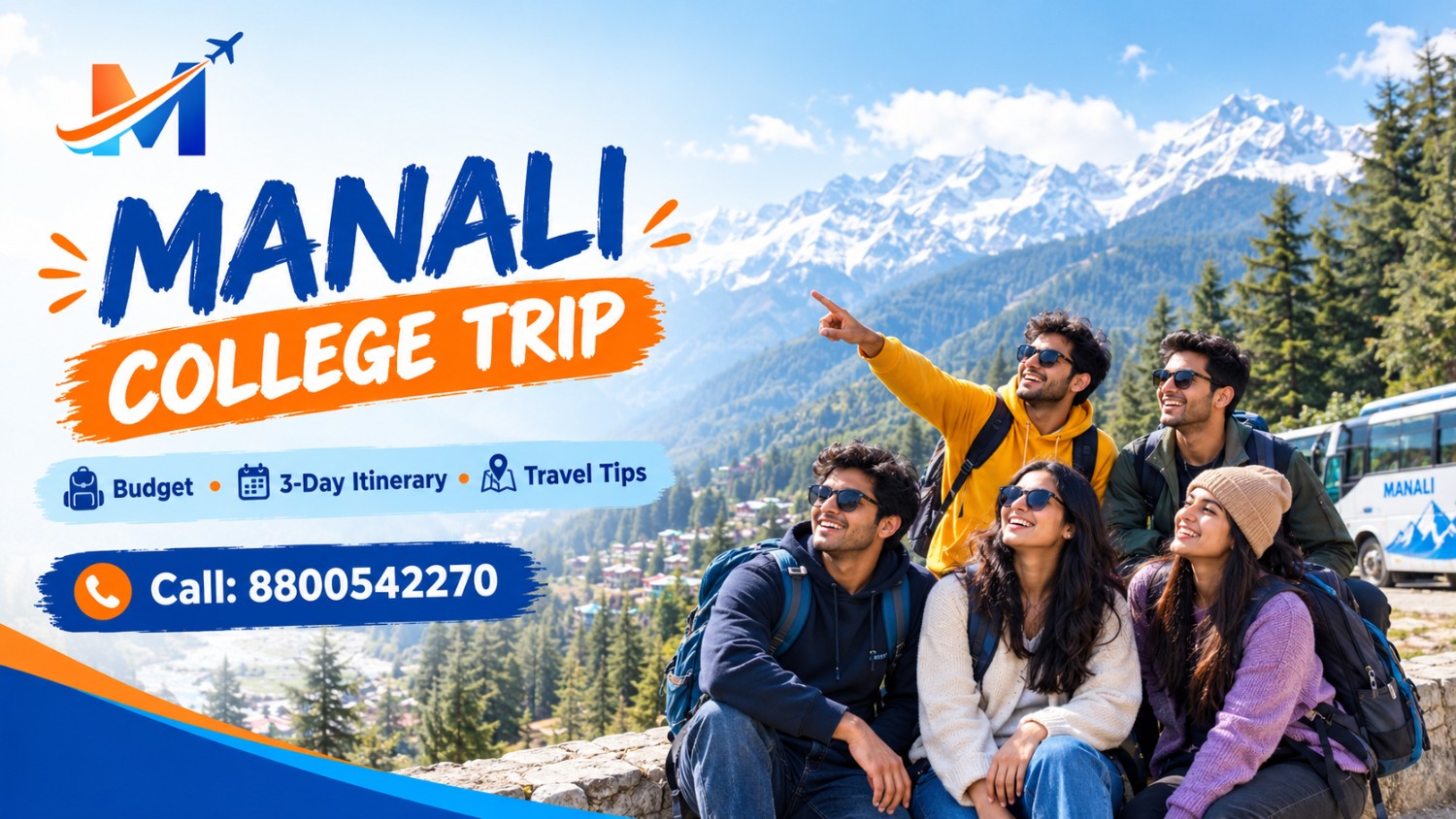
Plan a Manali college trip with a 3-day itinerary, student budget, adventure activities, travel options, group accommodation tips, and safety advice.
A college trip to Manali can combine mountain views, adventure activities, café hopping, scenic drives, and time with friends without requiring an elaborate holiday budget. The key is to plan around your group size, travel dates, transport, accommodation, and the activities everyone actually wants to experience.
For students travelling from Delhi or nearby cities, a Manali college trip of 3 days and 2 nights or 4 days and 3 nights is a practical starting point. An overnight Volvo journey can help save daytime travel hours, while shared rooms and group transport can make the overall cost more manageable.
This guide covers the best time to visit, how to reach Manali, realistic student budgets, a sample itinerary, places worth visiting, adventure options, accommodation choices, and essential safety tips. It is designed to help college societies, class representatives, student coordinators, and friend groups organise a trip that is enjoyable, affordable, and reasonably easy to manage.
Manali works well for student groups because it offers several kinds of experiences in one destination. Students who enjoy adventure can explore outdoor activities, while those who prefer a relaxed holiday can spend time in Old Manali, visit local cafés, explore temples, and enjoy the mountain scenery.
Here is what makes a Manali college tour appealing:
The biggest planning advantage is flexibility. A group of 20 students may prefer a common hotel and private vehicle, while a smaller group might find shared taxis and locally arranged activities more economical.
The best time depends on what your group wants to do. For pleasant weather and sightseeing, spring and early autumn are worth considering. For snow, winter is popular, but colder conditions and road disruptions require more preparation.
March to June — sightseeing and outdoor activities
A good period for exploring Manali town, enjoying mountain views, visiting Solang Valley when accessible, and spending time outdoors. May and June can be busy because of school and college holidays, so book transport and accommodation early.
September to November — a more relaxed mountain break
This period can suit students looking for scenic drives, café visits, photography, and sightseeing. September may still bring rain-related disruption, so check the forecast and road conditions before departure.
December to February — winter and snow experiences
Choose winter if seeing snow is a priority, but remember that snowfall is not guaranteed on your travel dates. Carry warm layers and keep the itinerary flexible in case roads close or outdoor activities are suspended.
July to August — monsoon travel
The landscape can be lush, but heavy rain may cause landslides, delays, and road closures. For a large student group working with a fixed return date, this season requires additional caution and a backup plan.
Planning tip: For a first-time college group, choose dates based on the activities you want rather than assuming snow or a particular road route will be available. Check local conditions shortly before travelling.
Manali is approximately 530–550 km by road from Delhi, depending on the route and starting point. The journey commonly takes around 12–15 hours by bus or car, though traffic, weather, roadworks, and holiday congestion can extend it. Himachal Tourism also recommends booking bus tickets in advance because of the long road journey.
For most student groups travelling from Delhi, an overnight Volvo or other suitable AC coach is a practical option. Students can travel together, avoid paying for a separate hotel night en route, and arrive in Manali the following morning.
Minto Holidays lists a Manali Volvo tour package from Delhi for travellers exploring a bus-based holiday option.
Before booking, check the actual boarding point, luggage allowance, arrival location, return departure time, and whether the coach is a seater or sleeper.
For a larger college group, a private vehicle may make coordination easier. A tempo traveller or coach can be considered depending on the final headcount, luggage, and operator availability.
Request a written quotation that explains the vehicle capacity, driver arrangements, parking, sightseeing kilometres, and any additional charges. Avoid choosing a vehicle based on the passenger count alone; luggage also needs sufficient space.
There is no direct railway station in Manali. Students can travel by train to a suitable connecting city, such as Chandigarh, and continue by road. Flights to Bhuntar or Chandigarh are another possibility, depending on schedules, fares, and onward transport.
For most budget-conscious college groups from Delhi, an overnight bus is simpler than coordinating separate train or flight tickets and transfers.
A well-planned itinerary should balance popular attractions with enough free time to enjoy the destination. Avoid squeezing every nearby attraction into one day simply to make the schedule look full.
1. Hadimba Devi Temple
Surrounded by tall cedar trees, this traditional wooden temple is one of Manali's best-known attractions. It is a good stop for architecture, photography, and a short walk. Keep noise low and respect temple customs.
2. Solang Valley
Solang Valley is popular for mountain scenery and seasonal adventure activities. Activity availability depends on weather, operating conditions, and local rules. Set a spending limit before the group arrives because activities are usually priced separately.
3. Mall Road
The main market is useful for shopping, snacks, casual meals, and an evening stroll. Give students a fixed meeting point and return time if they explore in smaller groups.
4. Old Manali
A good choice for students who enjoy cafés, quieter lanes, and a more laid-back atmosphere. Leave time for walking rather than treating it as a quick photo stop.
5. Vashisht Village
Known for its temple, village setting, and hot springs, Vashisht offers a different atmosphere from the main market. Check local bathing facilities and customs before visiting.
6. Atal Tunnel and Sissu, if conditions permit
This excursion offers dramatic mountain scenery beyond the tunnel. It needs a dedicated block of time, suitable transport, and a check of current road conditions. Do not assume that Sissu, snow points, or every road beyond the tunnel will be accessible.
Himachal Tourism lists Hadimba Devi Temple, Vashisht, and Solang Valley among Manali's attractions, with Solang Valley approximately 13 km from town and Hadimba Temple about 2.5 km away. Actual travel time depends on traffic and road conditions.
For a short college trip, the following plan keeps the schedule manageable without making every hour an activity.
Day 1
Arrive, settle in, and explore Manali
Day 2
Solang Valley and mountain experiences
Day 3
Local experiences and return journey
Important: A three-day schedule is not necessarily three full days at the destination. An overnight journey can mean the group arrives tired, and the return bus may depart early or in the evening. If you want to include Sissu, rafting, or multiple adventure activities, consider extending the trip to four days and three nights.
For a longer mountain holiday, a Shimla–Manali tour package from Delhi is another option to consider, although adding Shimla requires additional travel time and a revised itinerary.
A reasonable initial planning estimate for a Delhi-based college trip is around ₹5,000–₹10,000 per student for a 3-day/2-night or similar short budget trip, depending on transport, accommodation, meals, and sightseeing. This is a planning range, not a live quotation, and peak-season prices can be higher.
Budget separately for:
For budgeting, students can use three broad approaches:
Ask providers to clarify whether the quoted price includes return transport, taxes, meals, sightseeing, activity charges, and any seasonal supplements. A low headline price may not include the expenses students care about most.
The best location depends on the group's priorities.
For a Manali student group, confirm room capacity, separate room arrangements if needed, hot-water availability, meal timings, group dining space, late-arrival procedures, and cancellation terms. Check recent reviews and verify the actual property rather than relying only on photographs.
Depending on season, local availability, and safety conditions, students can consider:
Do not make adventure activities compulsory. Students should be free to opt out, and the group should agree on spending limits beforehand. Follow operator instructions and use the required safety equipment.
A college trip is also a chance to try Himachali and North Indian food. Look for siddu or other Himachali dishes when available, along with local trout preparations, rajma-chawal, momos, and café meals.
For a large group, inform restaurants about the headcount in advance. Students with food allergies or dietary restrictions should confirm ingredients directly instead of assuming every dish is suitable.
Organising a group trip requires more than booking tickets and choosing sightseeing spots. These steps can help avoid common problems.
For an excursion to Rohtang Pass, check the official Rohtang Pass permit portal for applicable permissions and current requirements. Access and permit conditions can change, and a permit does not guarantee that the route will remain open in poor weather.
A successful Himachal college trip should be enjoyable without putting students or local communities at risk.
A little flexibility is essential. If the weather makes a planned excursion unsafe, replace it with a local sightseeing day rather than taking unnecessary risks to follow the original schedule.
If your college society or student group would rather coordinate one trip plan than manage multiple bookings independently, Minto Holidays can be a starting point for discussing group travel arrangements.
Explore the Manali tour package from Delhi to review a destination-specific option. For groups comparing a wider range of mountain destinations, the Himachal tour package collection may also be useful.
When requesting a group quotation, share:
Ask for a written breakdown of inclusions, exclusions, payment terms, cancellation rules, and the final itinerary before confirming. This helps the group compare options fairly and understand the total cost.
Three days and two nights can work for local sightseeing and one excursion. Four days and three nights are more comfortable if the group wants to explore Old Manali, visit Solang Valley, include an excursion towards Sissu when accessible, and still have time to relax. Include travel time when counting your available days.
For a short budget trip from Delhi, use approximately ₹5,000–₹10,000 per student as an initial planning estimate. The actual amount depends on travel dates, room sharing, transport, meals, local taxis, and paid activities. Request a current quotation for your group size before collecting final payments.
Yes, it can work well for a group of that size if accommodation, transport, meals, and sightseeing are coordinated in advance. Confirm vehicle capacity, room allocation, meal timings, and group activity arrangements. It is also sensible to appoint several coordinators rather than expecting one student to manage the entire group.
An overnight Volvo is often a practical choice for students travelling from Delhi because it combines transport and overnight travel. However, compare fares, departure points, luggage limits, coach type, and arrival timings before booking. Allow time to rest after arrival instead of scheduling strenuous activities immediately.
March to June can suit sightseeing and outdoor activities, while September to November may appeal to groups seeking mountain scenery and a less summer-focused itinerary. December to February is an option for winter experiences, but snow and road access are not guaranteed. Monsoon travel requires additional flexibility.
Yes, when snow is available and designated activity areas are operating. Availability depends on weather, season, and local conditions, so avoid promising snow to every participant. Confirm the current activity location, charges, safety arrangements, and transport before making a booking.
It may be possible in favourable conditions, but it can make the trip rushed. Sissu requires additional road travel beyond Manali, and the journey can be affected by weather and traffic. A four-day trip gives the group more flexibility and reduces the need to squeeze several excursions into a short schedule.
Pack comfortable walking shoes, layered clothing, a warm jacket appropriate for the season, a rain jacket, personal medicines, sunscreen, a reusable water bottle, and a portable charger. Winter visitors may need additional thermal layers, gloves, and warm socks. Check the forecast shortly before leaving.
Travel outside the busiest holiday periods where possible, book transport and accommodation early, share rooms appropriately, compare itemised group quotations, and make expensive activities optional. Keep a separate emergency reserve instead of spending the entire budget on the package. Always compare what each quotation includes before choosing the cheapest option.
Verify transport, hotel details, room arrangements, meals, sightseeing, optional activity charges, taxes, payment deadlines, cancellation terms, and emergency support arrangements. Ask whether the advertised price is valid for your actual travel dates and group size. Keep the confirmed itinerary and payment receipts accessible to the coordinators.
A well-organised Manali college trip is about more than visiting famous attractions. It gives students time to explore the mountains, try new activities, enjoy local food, and share experiences without spending the entire holiday rushing between locations.
Start by deciding your dates, group size, and budget. Then choose suitable transport, book accommodation that can comfortably handle everyone, and keep the itinerary flexible enough for mountain weather.
If your college group needs help comparing transport, accommodation, and sightseeing arrangements, explore Minto Holidays' Manali options and discuss a plan that fits your group's requirements. A clear budget and realistic schedule will make it easier for everyone to enjoy the journey.