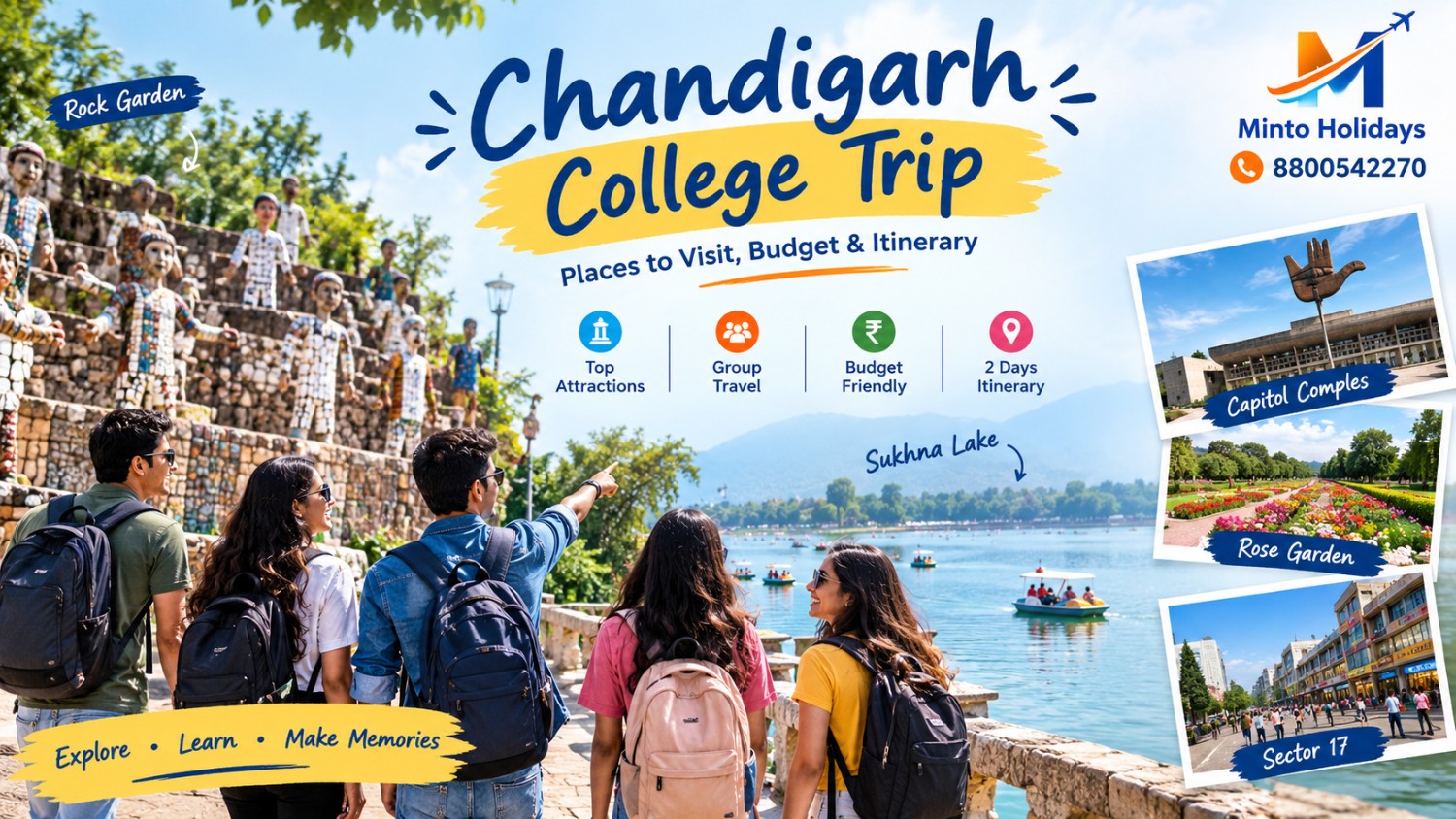
Plan a Chandigarh college trip with student-friendly attractions, a 2-day itinerary, travel options from Delhi, budget tips, food spots and group travel advice.
A Chandigarh college trip can combine architecture, art, outdoor activities, local food and relaxed time with friends without requiring a long holiday. The city’s organised layout makes it practical for student groups to explore several attractions over a weekend, especially when transport and sightseeing are planned in advance.
For colleges organising an educational excursion, a student society planning an outing or a group of friends looking for a short break, Chandigarh offers a useful mix of learning and leisure. Students can explore the creative installations at Rock Garden, spend time beside Sukhna Lake, visit museums and discover the city's distinctive urban design.
This guide covers the best places to visit, the ideal duration, travel options from Delhi, an estimated student budget, a sample itinerary and practical arrangements for organising a smooth college tour.
Chandigarh works well for a college excursion because its attractions cover several interests without requiring extensive intercity travel. Students interested in architecture, environmental design, photography, history, food and outdoor recreation can all find something worthwhile here.
Here is what makes the city suitable for student groups:
A particularly useful idea for colleges is to connect sightseeing with an academic activity. Architecture students can study the city's planning, fine arts students can analyse recycled-material sculptures at Rock Garden, and environmental science students can discuss wetland conservation around Sukhna Lake.
This makes the trip more meaningful than simply moving between tourist attractions.
A well-planned Chandigarh group travel itinerary should balance major attractions with breaks for meals, photographs and time to explore independently. For a two-day college trip, choose four to six main stops rather than trying to cover every attraction.
Suggested time: 2–3 hours
Rock Garden is a highlight for students interested in art, design and sustainability. Its sculptures, courtyards and pathways incorporate discarded household and industrial materials. The different sections also provide plenty of opportunities for group photographs.
Student activity: Ask small teams to identify how everyday waste has been repurposed into art.
Suggested time: 1–2 hours
Sukhna Lake is a good place to unwind after sightseeing. Students can enjoy the waterfront promenade, take photographs, observe birds during the appropriate season or check whether boating is available.
Student activity: Organise a short nature observation walk, followed by free time near the promenade. Keep the group away from restricted areas and follow local boating rules.
Suggested time: 1–2 hours, depending on access
The Capitol Complex is particularly relevant for architecture, civil engineering, political science and design students. Its monumental buildings and the Open Hand Monument illustrate Chandigarh's modernist architectural identity.
Guided tours have registration and access requirements. Check current arrangements and carry valid identification before visiting. The official tourism website lists guided tour slots and different access conditions for weekdays and weekends.
Suggested time: 45–90 minutes
This landscaped garden is suitable for a slower-paced stop between sightseeing activities. It is especially appealing during the flowering season, although the appearance of the garden varies throughout the year.
Student activity: Include a short photography assignment or a relaxed group walk. Avoid trampling flowerbeds or disturbing other visitors.
Suggested time: 1–2 hours
Add this museum to an educational itinerary focused on art, history, sculpture or cultural heritage. It offers a more structured learning experience than outdoor sightseeing.
Confirm the current opening days, entry rules and photography policy before finalising the schedule.
Suggested time: 1–2 hours
Sector 17 is a practical stop for shopping, snacks and a relaxed evening with friends. It can also work as a meeting point before returning to the hotel or boarding the bus.
Set a fixed regrouping time and meeting location, particularly when the college group has several dozen students.
If your group has extra time, consider these alternatives:
Check the latest visitor information before choosing optional attractions, as opening hours, admission rules and availability can change.
The period from September to April is generally suitable for a Chandigarh college tour, although the best month depends on the activities planned and the group's tolerance for heat or cold. Chandigarh Tourism also identifies this period as a favourable time to visit.
For a college group, October, November or March can be convenient choices, subject to academic calendars, accommodation rates and weather forecasts.
Chandigarh is accessible by road, rail and air. For most college groups travelling from Delhi or nearby North Indian cities, trains, buses or a hired coach are the practical options to compare.
The road distance is approximately 240–260 km, depending on the starting point and route. Allow around 5–7 hours as a broad planning estimate, with additional time for traffic, meal breaks and boarding arrangements. Actual travel time can vary considerably.
Options include:
For a large group, compare the full coach cost with per-person bus fares. A coach may simplify local transfers as well as the journey to and from Chandigarh, but confirm its permitted operating hours, seating capacity and parking arrangements.
Chandigarh Junction is connected to Delhi and several other major cities. A train can be a cost-conscious option, especially when tickets are booked early.
For a college booking, confirm the final passenger count before making reservations, check availability for the entire group and plan the transfer between the railway station and accommodation.
Shaheed Bhagat Singh International Airport serves Chandigarh and the surrounding region. Flying may be appropriate for colleges travelling from distant cities, but it is generally less economical for a short student trip originating in Delhi.
Check current flight schedules and include airport transfers when comparing total journey costs.
Two days and one night is a practical choice for a Chandigarh college trip from Delhi. It gives students enough time to explore the main attractions without turning the visit into a rushed checklist.
Choose your duration based on the group's travel time and academic objectives:
For groups travelling overnight from Delhi, remember that departure and arrival times affect the amount of usable sightseeing time. A schedule that looks comfortable on paper can become tiring if students have spent the night on a bus.
This itinerary is designed for a student group that wants a combination of educational sightseeing, outdoor activities and time with friends. Adjust the schedule according to your arrival time, weather and confirmed attraction timings.
Focus: Educational sightseeing and city exploration
Focus: Relaxed outdoor time and cultural learning
Planning tip: The schedule is illustrative, not a guarantee that every stop can be completed at those times. The Capitol Complex has specific access arrangements, while museums and gardens may have different opening days or hours. Verify these details before confirming transport and meal bookings.
If your bus arrives late on Day 1, prioritise Rock Garden and the evening outing rather than trying to squeeze in every attraction. If your return train or bus leaves early on Day 2, move the museum visit to the first day or drop it.
A two-day, one-night college trip can be planned on a student budget, but the final cost depends on group size, transport, accommodation, meal choices and paid activities.
For initial planning, use the following illustrative estimates per student, not live quotations:
These ranges assume a short trip of approximately two days and one night from Delhi or a similar starting point. They exclude major unexpected expenses and may not cover every optional activity.
Transport: A hired coach has a fixed trip cost, so the per-person amount generally falls when more students share the vehicle, provided the group fits within its legal seating capacity.
Accommodation: Dormitory-style or shared rooms can lower costs. Compare the total room allocation, number of beds, meal inclusions and student supervision arrangements rather than comparing room prices alone.
Food: Plan for breakfast, lunch, dinner and drinking water. Budget-friendly group meals are easier to organise when the restaurant knows the group size in advance.
Entry fees and activities: Rock Garden and other attractions may charge admission. Check current rates, group concessions, if any, and the cost of optional activities before preparing the final budget.
Local transfers: A coach that stays with the group may simplify movement between attractions, but its parking, driver allowance, permitted hours and other charges must be included in the quotation.
For an accurate estimate, obtain current quotations based on your departure city, dates, group size and accommodation requirements.
For a short student group visit, accommodation should make sightseeing and group management straightforward.
Consider these options:
Before confirming a property, check its group booking policy, room occupancy, washroom arrangements, meal availability, cancellation terms and late-arrival rules. Colleges should also verify that the accommodation is suitable for student groups and can support the institution's supervision requirements.
For a large class, ask for a rooming list in advance and confirm how students will be distributed across rooms. Separate arrangements for students and supervising faculty should follow college policy and individual requirements.
Food is part of the experience, and Chandigarh offers plenty of options for students with different budgets and preferences.
Consider trying:
For groups of 20 or more, contact restaurants ahead of time. Confirm seating capacity, meal service time, vegetarian and allergy-related requirements, payment arrangements and whether a fixed menu is available.
A pre-agreed menu can make lunch faster and reduce the risk of a long wait delaying the next attraction.
The logistics of a college tour become more important as the group grows. A plan that works for six friends may not work for 50 students.
A small group can often coordinate using one transport vehicle, shared accommodation and a common itinerary. Assign one or two student coordinators to assist the faculty lead with headcounts and communication.
Larger groups may need multiple vehicles, staggered attraction entry, prearranged meals and more structured room allocation. Confirm the total capacity of each vehicle and establish a clear plan for regrouping at every stop.
For educational visits, share the learning objective and expected conduct with students before departure. If the group includes a faculty member responsible for academic assessment, reserve time for observations, notes or a short discussion after each major visit.
A travel organiser can help coordinate coach hire, hotel reservations, sightseeing transfers and the overall itinerary. This can be especially useful when faculty members are already handling student permissions, attendance and academic arrangements.
Minto Holidays can be approached to discuss a customised student group itinerary based on the departure city, dates, number of participants, budget and preferred attractions. Request a written proposal with inclusions, exclusions, payment terms and cancellation conditions before confirming the booking.
For colleges that want to compare planned departures with a privately organised excursion, Minto Holidays also lists fixed-departure tour options. Check the actual departure details and suitability for your student group before making a decision.
Although this guide focuses on college travel, the city can suit different interests and group preferences.
The best itinerary is the one that fits the group's interests, available time and budget, rather than the one with the highest number of attractions.
A little preparation can prevent common problems during a student excursion.
For trips during the summer or monsoon, keep the itinerary flexible. Heat, heavy showers or traffic can affect outdoor activities and travel time. Allow enough buffer to reach the departure point without rushing.
Some planning errors can make even a short excursion more expensive or tiring than expected.
Trying to visit too many attractions: Rock Garden alone may require two to three hours. Allow realistic time for each stop instead of scheduling attractions back-to-back.
Choosing accommodation based only on price: A cheaper property far from the planned sightseeing route may increase transport costs and reduce time available for activities.
Ignoring entry and registration rules: Certain attractions have specific visitor requirements. Confirm these before paying for transport or publishing the final itinerary.
Leaving meals unplanned: A large group arriving at a restaurant without notice can face long waits. Pre-book meals or identify suitable alternatives.
Not confirming the return journey: Keep departure time, pickup point, luggage arrangements and the responsible coordinator's contact details in the group itinerary.
Collecting money without a clear budget: Give participants a written estimate and explain which expenses are included, which are optional and how any changes will be handled.
A successful Chandigarh college trip combines well-chosen attractions, realistic travel timings, a clear student budget and organised group coordination. Two days are usually enough to experience the city's architecture, creative spaces, gardens and local food without overloading the schedule.
Start by confirming the number of students, departure city, travel dates and academic objectives. Then shortlist attractions, obtain transport and accommodation quotations, and prepare a practical itinerary with enough flexibility for meals and unexpected delays.
If you want help coordinating transport, stays and sightseeing for your college group, contact Minto Holidays to discuss a customised itinerary that fits your requirements. Compare the proposed inclusions and costs before confirming your arrangements.
Yes. Chandigarh offers a mix of architecture, art, museums, gardens, outdoor spaces and food experiences. It works particularly well for short educational excursions because students can combine learning activities with leisure. Architecture, fine arts, environmental science and history groups can tailor their visits to specific academic interests.
For a two-day, one-night trip from Delhi, a preliminary budget of around ₹2,500–₹6,500 per student may be a useful starting point, depending on transport, accommodation and meals. Premium arrangements can cost more. Obtain current quotations for your dates and group size before finalising the contribution per student.
Yes, if the group starts early and selects a limited number of attractions. Rock Garden, Sukhna Lake and one additional stop may form a manageable day trip, depending on the starting point and opening hours. A two-day visit is more comfortable for students travelling from Delhi.
October and November are worth considering for outdoor sightseeing, while March and early April can also be suitable. September may bring rain, and May and June can be very hot. Choose dates based on the academic calendar, expected weather, accommodation availability and the activities planned.
Rock Garden, Sukhna Lake, Capitol Complex, Zakir Hussain Rose Garden, Government Museum and Art Gallery, and Sector 17 Plaza are useful options. Architecture and design students may also benefit from visiting the Le Corbusier Centre, subject to its current opening arrangements.
Yes, provided the logistics are planned carefully. Larger groups may require multiple vehicles, coordinated room allocation, prearranged meals and clear meeting points. Confirm vehicle capacities, attraction access requirements and faculty-supervision arrangements well before departure.
A hired coach is convenient when the entire group needs to travel together and requires local transfers. Trains and intercity buses can be economical alternatives, particularly for smaller groups. Compare the total cost, journey duration, pickup arrangements and local transportation requirements before deciding.
Students should carry identification, comfortable walking shoes, weather-appropriate clothing, a water bottle, personal medication where needed, a phone charger and some emergency cash. Sunscreen is useful in warmer months, while a rain jacket or warm layers may be necessary in other seasons. Follow the college's packing and conduct instructions.
Not every attraction requires the same arrangements. However, sites such as the Capitol Complex have specific access and registration conditions, and museums or other venues may have separate group policies. Contact the relevant visitor service, confirm any required identification and arrange guided visits in advance where applicable.
You can contact Minto Holidays to discuss a student group itinerary based on your departure city, dates, group size, budget and preferred activities. Ask for a detailed quotation covering transport, accommodation, meals, sightseeing and any additional charges so that your college can assess the proposal before booking.