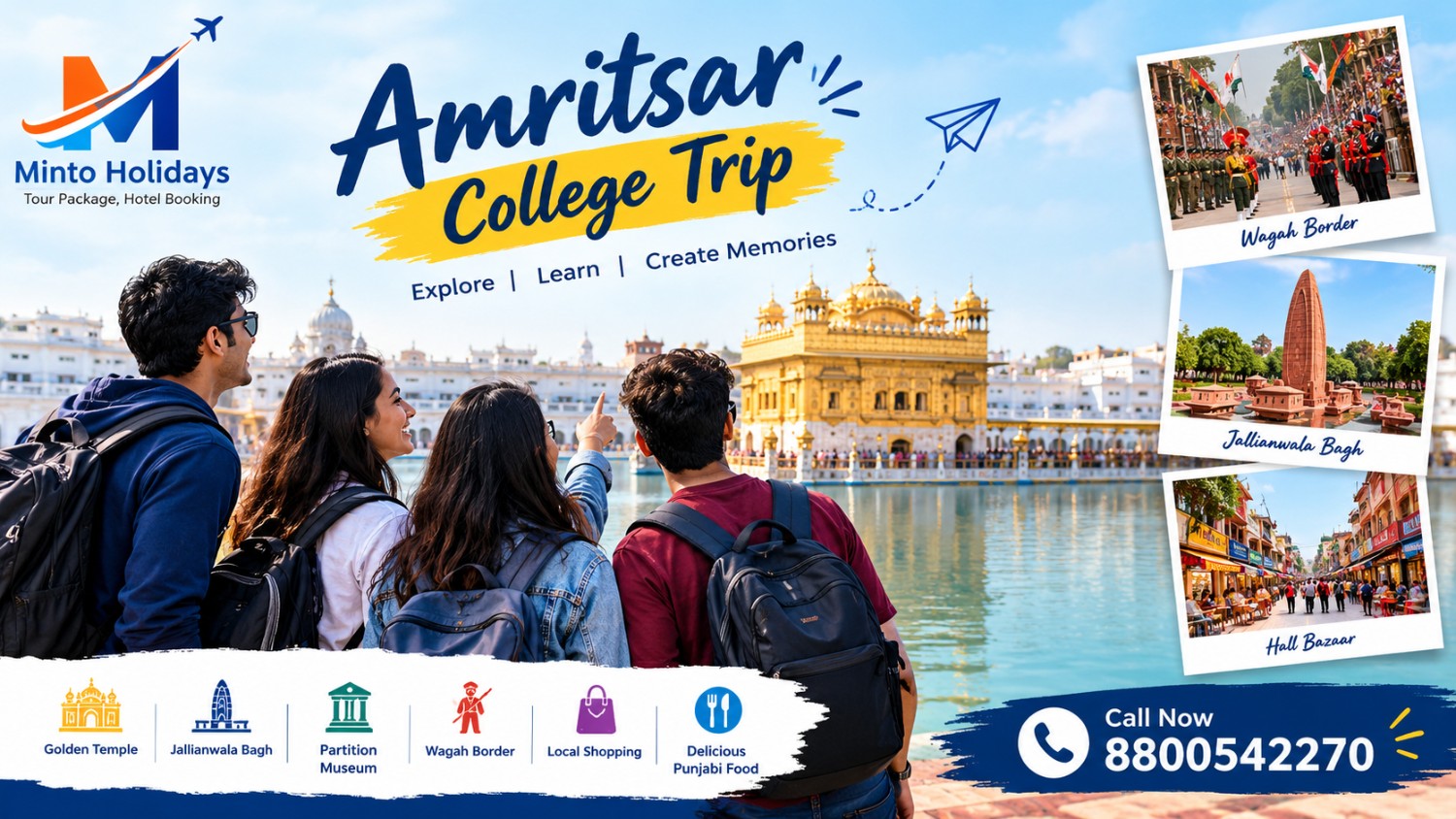
Plan an Amritsar college trip with a student-friendly itinerary, Golden Temple visit, Wagah Border ceremony, budget tips, transport options and group travel advice.
An Amritsar college trip is a rewarding way for students to experience Punjabi culture, Sikh heritage, Indian history, local food and a memorable group outing without needing a long holiday. From the peaceful surroundings of the Golden Temple to the patriotic atmosphere of the Wagah Border ceremony and the historic Jallianwala Bagh memorial, the city offers a mix of educational experiences and opportunities to spend time with classmates.
For most college groups, 2 days and 1 night is a practical starting point. It gives students enough time to explore the main attractions, enjoy local food and travel together without making the schedule too hectic. Groups arriving from farther cities may prefer 3 days to allow for overnight train or bus journeys.
This guide covers the best places to visit, a sample itinerary, transport options, estimated student budgets, accommodation advice and practical tips for organizing a smooth college tour to Amritsar.
Amritsar works particularly well for student groups because its attractions combine learning, culture and leisure within a relatively compact city.
A well-planned Punjab college trip should balance sightseeing with enough free time for meals, rest and group coordination. Trying to fit every attraction into a few hours often makes the experience more tiring than enjoyable.
A good student itinerary should combine major attractions with places that encourage discussion, photography, cultural understanding and relaxed time with friends.
The Golden Temple is the spiritual heart of Amritsar and a must-visit stop for students. Its architecture, sacred pool, devotional music and community kitchen make it a meaningful cultural experience.
Allow around 1.5–3 hours, depending on the crowd and whether your group wishes to participate in langar. Cover your head, remove footwear, dress modestly and follow the instructions displayed within the complex.
This memorial commemorates the tragic massacre of 13 April 1919. It is especially relevant for college students studying modern Indian history, the freedom movement or political science.
Keep the visit respectful and give students time to read the memorial information instead of treating the site only as a photography stop.
The Partition Museum explores the human impact of the 1947 Partition through personal belongings, archival material and accounts of displacement. It is a valuable addition to a history-focused college tour.
Plan at least an hour, and longer if your group wants to explore the exhibits in detail. The museum's published visitor information lists it as closed on Mondays, so check the current schedule before finalizing your itinerary.
The flag-lowering ceremony is one of the most energetic experiences on an Amritsar student trip. The synchronized drills, marching and crowd atmosphere make it memorable for a group.
The border is roughly 30 km from Amritsar, but traffic and security arrangements can affect the journey. Reserve a substantial part of the afternoon, arrive well before the ceremony and confirm the latest timing before departure because schedules can change seasonally.
5. Gobindgarh Fort
This historic fort can add a heritage and cultural element to the trip. Depending on current programming, students may find exhibits or cultural activities that make the visit more interactive.
Check the current entry fees, operating hours and available attractions before including it in a fixed schedule.
Hall Bazaar is a practical place to experience local shopping, traditional Punjabi juttis, textiles and everyday city life. Students can explore in small groups and purchase souvenirs within a set budget.
Agree on a meeting point and return time before allowing free exploration, especially when the group has 20 or more participants.
October to March is generally a comfortable period for sightseeing in Amritsar. Days are often more suitable for walking and outdoor activities than during the peak summer heat, although winter mornings and evenings can be quite cold.
For a college group, the best dates are not always the cheapest dates. Compare transport fares, hotel availability, examination schedules and local festivals before confirming the departure.
Amritsar is accessible by train, road and air. The most practical option depends on where the college is located, the group size and the available budget.
Amritsar Junction is a useful arrival point for groups travelling from Delhi and other major cities. Rail travel can be economical for larger student groups, particularly when bookings are made well in advance.
A private bus or tempo traveller can be convenient for colleges travelling from nearby cities. It gives the group flexibility for pick-ups, luggage and sightseeing.
From Delhi, road travel generally takes around 7–9 hours, depending on traffic, route, weather and stops. Treat this as a planning estimate rather than a guaranteed journey time.
For a large student group, confirm the vehicle's permitted seating capacity, luggage space, driver arrangements and any applicable state or tourist-vehicle requirements.
Sri Guru Ram Dass Jee International Airport is suitable for groups travelling from cities with convenient flight connections. Air travel can save time, but fares and baggage costs may make it less economical for a large college group.
Planning tip: Compare the complete cost per student, including transfers from the airport or railway station, rather than comparing only the flight, train or bus ticket.
A two-day plan works well for groups that arrive in Amritsar early on the first day and leave late on the second day. If your transport timings do not allow this, add a night rather than squeezing the visits together.
Morning
Golden Temple and Jallianwala Bagh
Begin with the Golden Temple, allowing time for the visit and langar if desired. Continue to Jallianwala Bagh and discuss the historical significance of the site.
Afternoon
Lunch and the Partition Museum
Have lunch at a suitable local restaurant, then explore the Partition Museum if it is open. Keep a backup activity in mind if your visit falls on a closing day.
Late afternoon
Attari–Wagah Border
Leave enough time for the drive, security checks and seating. Confirm the day's ceremony timing and access arrangements in advance.
Morning
Breakfast and local exploration
Enjoy Punjabi breakfast options such as Amritsari kulcha and chole, subject to individual dietary preferences. Visit Gobindgarh Fort if the current schedule and budget suit the group.
Afternoon
Hall Bazaar and departure
Allow time for souvenir shopping, lunch and collecting luggage. Keep sufficient transfer time for the train, bus or flight.
Important: This itinerary is a framework, not a fixed timetable. Arrival and departure schedules, museum closing days, traffic and the border ceremony may require changes. If the group is particularly interested in history, allow more time for the museum and consider reducing shopping.
The cost of an Amritsar college tour depends on the departure city, transport, number of students, room-sharing arrangements, meals and sightseeing choices. For initial planning, a 2-day, 1-night trip within Amritsar may require approximately ₹2,500–₹5,000 per student, excluding long-distance travel to the city.
These are indicative planning estimates, not live quotations. Actual costs may be higher during busy dates or when the group requires premium accommodation or private transport.
The estimates above exclude the journey to and from Amritsar. Add the applicable train, bus or flight fare to calculate the complete trip budget. Some attractions may be free to enter, while others charge admission or offer separately priced activities.
For students travelling from Delhi, a rough initial budget for a 2-day, 1-night trip might be ₹3,500–₹7,000 per person including economical round-trip transport, depending on the transport mode and departure dates.
Train and shared-vehicle options may help control costs, while flights and premium hotels can increase the total substantially. Verify actual fares before collecting money from students.
A low headline price is not necessarily the best deal. Confirm whether it includes taxes, driver charges, parking, tolls, meals and any additional sightseeing expenses.
For a short student tour, accommodation near the Golden Temple, the Heritage Street area or a well-connected central neighbourhood can reduce travel time to the main attractions.
These may work for students who prioritize affordability. Before confirming a property, check room capacity, bathroom arrangements, cleanliness, security and whether it accepts large student groups.
Budget hotels can provide a practical balance of cost and convenience. Ask for a written group quotation with the number of rooms, occupancy, meal arrangements, check-in times and cancellation terms.
For larger batches, a hotel that can accommodate everyone in one property may simplify supervision, room allocation and departure coordination. However, do not assume that a property has enough rooms just because it accepts group bookings.
A useful booking tip: Ask the accommodation provider to confirm the final rooming list, late-arrival arrangements and an emergency contact before the trip. If students are minors, the college should also establish appropriate supervision and safeguarding arrangements.
Food is an important part of the Amritsar experience, and students can sample local dishes without making every meal expensive.
For a student group, arrange at least some meals in advance so everyone can eat together and the schedule stays manageable. Check vegetarian, vegan, allergy-related and other dietary requirements before choosing restaurants.
At the Golden Temple, langar is a community meal offered to visitors. Students should approach it respectfully, follow the volunteers' directions and avoid treating the experience as a tourist activity alone.
A college trip requires more coordination than an ordinary family holiday. These steps can help avoid common problems.
Amritsar's religious and historical sites deserve a respectful approach. Cover your head and remove footwear where required at the Golden Temple, dress appropriately, follow photography restrictions and avoid loud behaviour in prayer areas or memorial spaces.
At Jallianwala Bagh and the Partition Museum, encourage students to engage thoughtfully with the history rather than rushing through the exhibits.
Planning a student trip involves coordinating transport, rooms, meals, sightseeing and individual budgets. Minto Holidays can be approached for help with a group itinerary and arrangements tailored to the college's departure city, batch size, travel dates and budget.
If the trip is part of a longer holiday, you can also explore Minto Holidays' Amritsar, Vaishno Devi and Kashmir tour package from Delhi. This is a broader multi-destination itinerary, so confirm its suitability for a student group rather than assuming it is a dedicated college package.
For groups interested in combining Amritsar with a Himachal journey, the Grand Himachal tour package with Golden Temple from Delhi is another option to review. The route and duration should be checked against your college's schedule and budget.
Before making a booking, request a written itinerary and confirm inclusions, exclusions, group capacity, payment terms and cancellation conditions. This makes it easier for the college to approve the plan and for students to understand what they are paying for.
Two days and one night are usually sufficient to visit the Golden Temple, Jallianwala Bagh, the Partition Museum and the Attari–Wagah Border ceremony. A three-day trip is more comfortable for groups travelling from distant cities or wishing to include additional attractions and relaxed group activities.
A basic two-day trip within Amritsar may cost around ₹2,500–₹5,000 per student, excluding long-distance travel. For students travelling from Delhi, a preliminary budget of ₹3,500–₹7,000 including economical return transport may be a useful starting point. Actual expenses depend on travel dates, accommodation, meals and group size.
Yes. Its main attractions can be combined into a manageable itinerary, and groups can arrange shared transport and accommodation. For larger batches, divide students into smaller supervised groups, assign coordinators and establish clear meeting points before sightseeing.
The Golden Temple, Jallianwala Bagh, the Partition Museum and the Attari–Wagah Border ceremony are strong priorities. Gobindgarh Fort and Hall Bazaar can be added if time permits. Students interested in history may prefer spending longer at the memorials and museum instead of adding too many stops.
October to March is generally suitable for sightseeing, although winter mornings can be cold and fog may affect transport. April to June can be very hot, while the monsoon season may bring rain. Check the forecast and transport conditions before finalizing dates.
Yes, provided the group arrives early enough and leaves sufficient time for the journey to the border. A morning Golden Temple visit followed by lunch and an afternoon transfer can work, but the schedule should remain flexible. Confirm the latest ceremony timing and allow for security checks and traffic.
Admission arrangements and seating policies should be confirmed through current official guidance before travel. Do not assume that every access or seating option is free or that the schedule will remain unchanged. Groups should verify current entry requirements and arrive well before the announced ceremony time.
Pack comfortable walking shoes, modest clothing, a head covering for the Golden Temple, a reusable water bottle, personal medicines, identification and a phone charger. Carry warm layers in winter and sun protection during hotter months. Follow attraction rules regarding bags, photography and restricted items.
Yes. Students can learn about Sikh heritage, community service, the Indian freedom movement and the human consequences of Partition. Faculty members can make the visit more meaningful by preparing discussion questions or a short reflection activity around the historical sites.
You can contact Minto Holidays to discuss a group itinerary based on the college's travel dates, departure city, number of students and budget. Ask for a customized quotation and verify the transport, accommodation, meals, sightseeing arrangements and cancellation terms before confirming.
An Amritsar college trip can bring together history, cultural learning, Punjabi cuisine and shared experiences in a short, manageable holiday. The key is to prioritize the main attractions, choose transport that suits the group, set a realistic budget and leave enough flexibility for delays.
Start by confirming your student count, preferred dates and departure city. Minto Holidays can help you explore suitable group travel arrangements and, where appropriate, extend the journey to nearby destinations. A well-organized itinerary makes the experience easier for students and coordinators alike.