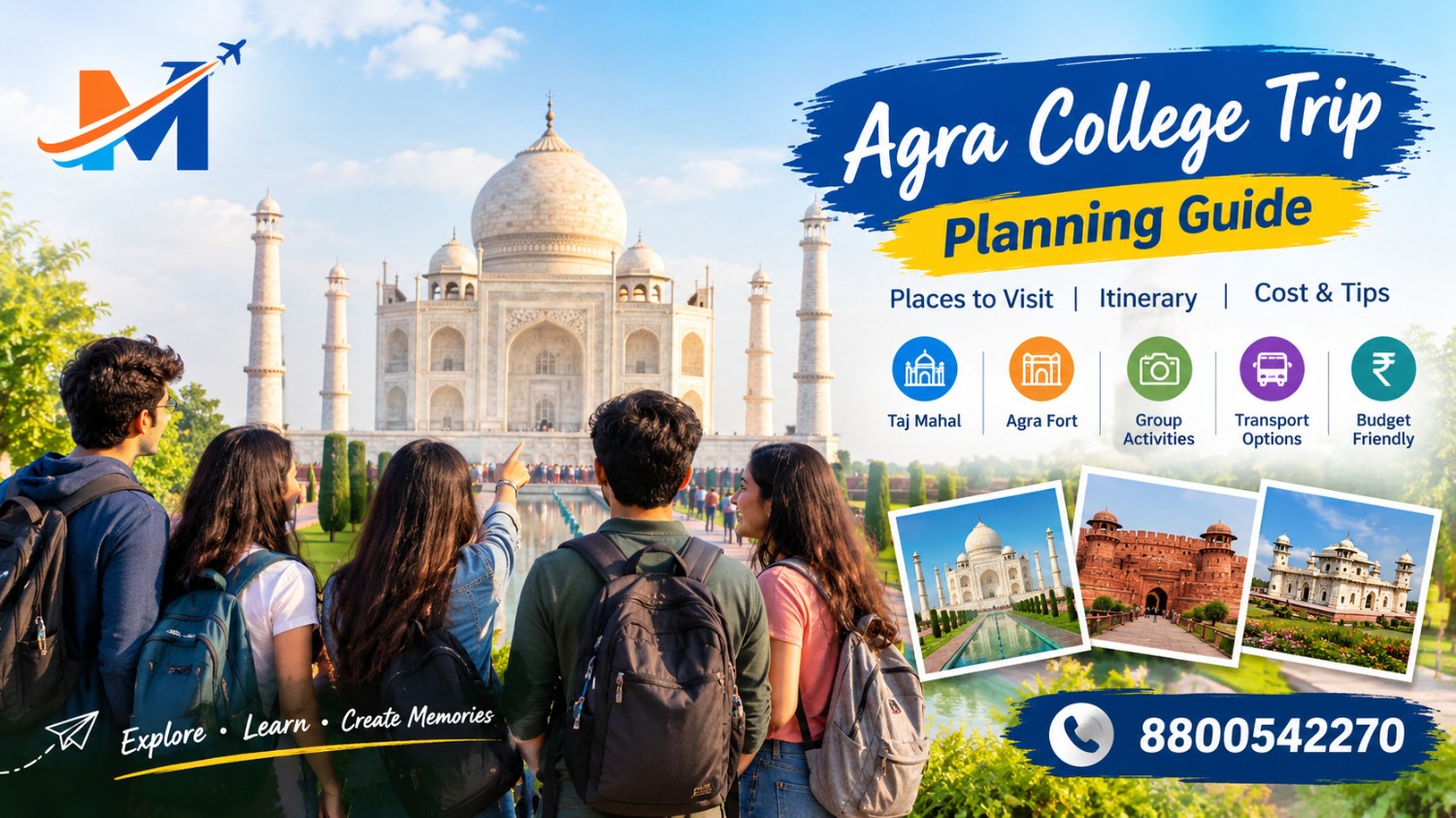
Plan an Agra college trip with student-friendly attractions, a 1-day itinerary, budget estimates, transport options, group activities and practical travel tips.
An Agra college trip can combine history, architecture, photography, cultural learning and a memorable day out with classmates. Home to the Taj Mahal, Agra Fort and other important Mughal-era monuments, the city is an excellent choice for college excursions, history department visits, student societies and educational tours.
For most colleges travelling from Delhi NCR, Agra works well as a one-day trip, although an overnight stay gives students more time to explore monuments, local markets and nearby heritage sites without rushing. The key is to plan transportation, group entry, meals, student budgets and sightseeing timings together.
This guide covers the best places to visit, how to reach Agra, a practical itinerary, estimated student expenses, group travel arrangements and safety tips to help colleges organize a smooth and educational trip.
Agra offers more than a famous monument. It gives students an opportunity to connect classroom learning with real examples of Mughal architecture, historical urban planning, craftsmanship, tourism management and heritage conservation.
Here is why it suits different types of student groups:
Agra is also practical for colleges with limited time because several major attractions can be covered in a compact itinerary. However, queues, security checks, walking distances and traffic can make sightseeing take longer than expected, particularly on weekends and public holidays.
A successful student itinerary should prioritize a few meaningful attractions instead of trying to cover every monument in one day.
The Taj Mahal is the main attraction for most college excursions. Students can observe its white marble construction, symmetry, calligraphy, inlay work and landscaped setting while learning about Mughal architecture and the history behind its construction.
Suggested time: 2–3 hours, allowing for entry procedures and walking.
This historic fort provides useful context for understanding Mughal administration, royal life, defensive architecture and the development of the imperial capital. Its courtyards, gates and palace structures make it particularly relevant for history and architecture students.
Suggested time: 1.5–2 hours.
Located across the Yamuna River from the Taj Mahal, this garden is an option for students interested in Mughal landscape design and alternative views of the monument. It is best considered when the group has enough time after its main sightseeing stops.
Suggested time: 45–60 minutes.
Often called the Baby Taj, this tomb is worth considering for a more detailed look at decorative marble work, geometric patterns and Mughal tomb architecture. It is a useful alternative to adding several distant attractions to an already packed schedule.
Suggested time: 45–60 minutes.
This UNESCO-listed historic city is an option for a longer educational excursion. Its palaces, courtyards and monumental gateways offer insight into Mughal urban planning and architecture. It lies outside Agra city, so it is generally better suited to a two-day itinerary or a separate full-day visit.
Suggested time: 2–3 hours on site, plus road travel.
For a one-day college trip, prioritize the Taj Mahal and Agra Fort. Add one other attraction only if the group's arrival time, transport arrangements and entry queues leave enough room.
The most comfortable period for an Agra college tour is generally October to March, when outdoor sightseeing is usually more manageable than during the hottest months.
For colleges, the best date is not necessarily the one with the best weather alone. Check examination schedules, attendance requirements, campus permissions and expected tourist crowds before confirming transport.
Planning tip: An early start is particularly valuable if your group wants to visit the Taj Mahal and Agra Fort on the same day. Check the current opening schedule, weekly closure days, ticket availability and monument-specific rules on official sources before booking. The Taj Mahal is generally closed to visitors on Fridays, so avoid scheduling a standard sightseeing visit that day.
Agra is accessible by road and rail, making it a practical destination for colleges travelling from Delhi, Noida, Gurugram and other parts of northern India.
For a group of 30–50 students, a suitably sized private coach is often easier to coordinate than arranging individual cars. For larger batches, the college may need multiple vehicles, a larger coach where suitable, or separate departure groups.
Students travelling from Jaipur, Lucknow, Chandigarh or other cities should compare direct rail connections with road transfers. If students are arriving from different locations, establish one meeting point and a clear reporting time rather than expecting everyone to reach each monument independently.
For transport and sightseeing arrangements, colleges can explore the Agra day tour package from Delhi as a starting point when discussing a suitable group itinerary with Minto Holidays. Confirm the actual inclusions, capacity, pricing and availability before making a booking.
A one-day itinerary works best when the college leaves early and keeps the sightseeing list realistic. The following schedule is an example for a group travelling from Delhi NCR; actual timings will depend on the departure point, traffic and ticket arrangements.
5:00 AM
Departure from Delhi NCR
Assemble at the designated pickup point, check attendance and start the journey with packed breakfast or a planned breakfast stop.
9:00 AM
Visit the Taj Mahal
Explore the monument with an approved guide or faculty-led explanation. Allow time for entry checks, group coordination and photographs.
12:00 PM
Lunch break
Arrange a hygienic restaurant meal or pre-planned group lunch. Confirm seating capacity and meal costs beforehand.
1:00 PM
Explore Agra Fort
Visit its historic structures and discuss their architectural and historical significance.
3:00 PM
Optional short stop
If time permits, visit a nearby attraction or make a brief, supervised stop for local snacks or handicraft shopping. Skip this if the group is running late.
4:00 PM
Return journey
Conduct a headcount, confirm that everyone is on board and depart for Delhi NCR. Arrival time will depend on traffic and the departure location.
These are planning estimates rather than guaranteed entry or departure times. Adjust the schedule to the group's actual transport booking, monument opening hours and ticket slots.
A two-day trip is worth considering if the group is travelling from farther away or wants to include Fatehpur Sikri, Mehtab Bagh or Itmad-ud-Daulah's Tomb without rushing.
On the first day, visit the Taj Mahal and Agra Fort, explore a local market if time permits, and stay overnight. On the second day, visit one or two additional attractions before returning. For a broader heritage excursion, a combined Agra, Mathura and Vrindavan tour package can be considered, with the itinerary adapted to the college's priorities.
Remember that Mathura and Vrindavan add extra travel and sightseeing time. They should not be treated as quick stops on an already crowded Agra day trip.
The cost of an Agra college trip depends on the starting city, group size, transport type, accommodation, meals, entry tickets and guide arrangements.
For a one-day trip from Delhi NCR, a preliminary planning budget could be:
These are indicative planning estimates, not live quotations. Actual expenses may fall outside these ranges, especially for smaller groups, premium transport, higher-cost accommodation or additional destinations. Monument entry fees should be checked separately against current official rates and the applicable visitor category.
For transparent budgeting, prepare a per-student estimate and explain which costs are included before collecting money. If faculty members, drivers or accompanying coordinators need separate arrangements, account for those expenses too.
For a one-day trip, accommodation is usually unnecessary for groups coming from Delhi NCR. Students travelling from farther away may prefer a hotel or hostel arrangement with easy access to the planned sightseeing route.
When selecting accommodation for a college group, prioritize:
For local sightseeing, a pre-arranged coach or group vehicle is generally easier to manage than asking students to find separate auto-rickshaws or taxis at every stop. Agree on pickup points and waiting times in advance. If using local transport, confirm fares before departure and keep students together in small supervised groups.
An educational trip can include local food and crafts without turning the schedule into a shopping tour.
Agra is known for petha, a sweet traditionally made from ash gourd, as well as Mughlai-inspired dishes and a range of North Indian snacks. Choose clean, well-reviewed eateries that can serve the whole group efficiently, and ask about ingredients or dietary requirements in advance.
Students can also explore local marble inlay work and handicrafts. If the college includes a shopping stop, establish a time limit and meeting point, and make sure students understand that prices and product quality vary.
For an educational angle, faculty members could ask students to document a local craft, research the history of a monument, or prepare a short photo essay. This gives the excursion a clear learning outcome without making every moment feel like a classroom activity.
A college excursion needs more coordination than an ordinary outing, especially when dozens of students are travelling together.
For a day trip, students generally need a small backpack containing:
Avoid carrying unnecessary valuables or bulky luggage. Check the latest monument security rules before departure because permitted items can differ by site.
A few small decisions can make the difference between a well-managed educational excursion and a tiring day.
For colleges that need assistance coordinating transport, accommodation, sightseeing and meals, Minto Holidays can be approached to discuss a group itinerary based on the student count, departure city, available budget and trip duration. Confirm all arrangements and package inclusions before payment.
Yes. Agra is suitable for a one-day excursion, particularly for colleges travelling from Delhi NCR. Students can generally plan visits to the Taj Mahal and Agra Fort, with a lunch break and a short additional stop if time permits. An early departure is important, and the group should allow flexibility for traffic, entry procedures and walking time.
A one-day trip from Delhi NCR may be budgeted at approximately ₹1,200–₹3,500 per student, depending on group size, transport, meals and sightseeing arrangements. A two-day excursion with accommodation may cost ₹3,500–₹6,500 or more. These are planning estimates, not confirmed prices, so request quotations and check current monument fees before collecting contributions.
The Taj Mahal and Agra Fort are the two main priorities for most student groups. Mehtab Bagh and Itmad-ud-Daulah's Tomb are useful additions for architecture and heritage studies. Fatehpur Sikri is better suited to a longer excursion because it requires additional road travel and sightseeing time.
October through March is generally a comfortable period for outdoor sightseeing. December and January can bring cold mornings and fog, while March can become warm. Summer requires additional precautions against heat, and monsoon travel calls for flexibility. Colleges should also consider examination schedules, public holidays and expected tourist crowds.
Yes. Agra provides opportunities to study Mughal architectural features, symmetry, domes, arches, decorative stonework, gardens and the relationship between historic buildings and their surroundings. Faculty members can make visits more meaningful by preparing observation questions or short assignments before departure.
One day is usually sufficient for the Taj Mahal and Agra Fort. Two days allow a more relaxed schedule and the option to add other monuments or Fatehpur Sikri. A longer itinerary may be appropriate if the college also wants to include Mathura and Vrindavan, but those destinations require additional transport and sightseeing time.
Yes, provided transport capacity, tickets, meals and supervision are planned around the group size. Colleges may need multiple vehicles or a suitable large coach, along with designated coordinators and clear attendance procedures. Request a group-specific quotation because the cost per student and operational arrangements depend on the actual requirements.
Advance ticket planning is advisable, especially for large groups and busy travel periods. Check the official Archaeological Survey of India ticketing information for current ticket availability, visitor categories, opening details and entry conditions. Do not assume that a group can enter together without completing the applicable booking and security procedures.
Comfortable, weather-appropriate clothing and walking shoes are practical choices. Carry a cap and sunscreen in hot weather, or a warm layer during winter. Students should follow monument regulations and show respect at religious or culturally significant locations. Avoid footwear that becomes uncomfortable during extended walking.
Minto Holidays can be contacted to discuss transport, sightseeing, meals, accommodation and itinerary planning for a student group. Share the departure city, approximate number of students, preferred dates, budget per person and whether the trip is for one or two days. Request a written itinerary and confirm inclusions, exclusions, cancellation terms and availability before booking.
A well-organized Agra college trip can offer students a valuable combination of historical learning, architectural discovery and time with classmates. The most effective itinerary is not necessarily the one with the greatest number of attractions; it is the one that balances travel time, meaningful sightseeing, student comfort and budget.
Start by confirming the group size, departure point and preferred dates. Then shortlist the monuments, arrange transport and meals, and keep the schedule flexible enough to handle delays.
If your college needs help coordinating the details, contact Minto Holidays to discuss a group travel plan suited to your requirements. You can also review the available Agra sightseeing package and ask whether its arrangements can be adapted for your student group.